Posts

Esteban/Estevanico Reading 2.1
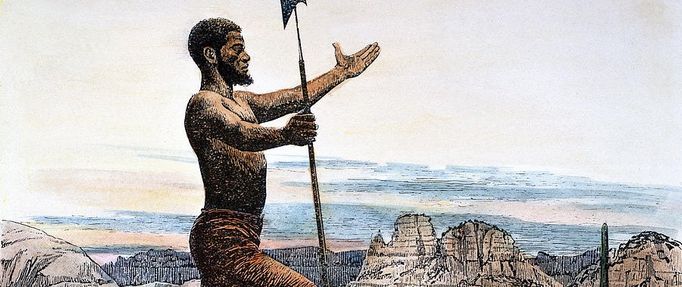
Image
Estevanico, the First African Man to Explore the Americas His contribution to various expeditions has been largely overlooked. By Lee D'Amato | Published Nov 18, 2022 Adapted from: https://explorethearchive.com/estevanico Photo Credit: Texas State Historical Association One of the earliest explorers of North America was an African-born slave by the name of Esteban de Dorantes, or Estevanico. Despite his indispensable role in European exploration and colonization of the Americas, Estevanico is often sidelined in historical accounts…  The mystery surrounding Estevanico begins with his first breath. We know that he was born circa 1500, and his birth name, Mustafa Azemmouri, suggests that he hailed from the Moroccan city of Azemmour. It is unknown how he came to be a slave, but he was eventually purchased by AndrĂ©s Dorantes de Carranza, the son of a Spanish lower nobleman. At Dorantes’ insistence, Azemmouri converted to Catholicism and took the name Estevan, from which he eventually g...

Reading 4: Growing Political Violence/Polarization in Ancient Rome

During the decline of the Roman Republic, political violence and polarization escalated, ultimately contributing to its downfall. Fierce rivalries between political factions, such as the Optimates (conservative aristocrats) and Populares (populist reformers), often erupted into street violence, assassinations, and civil wars. These divisions tore at the fabric of Roman society and undermined the stability and functionality of the Republic's political system.  The polarization in ancient Rome stemmed from competing interests and ideologies within the ruling elite. The Optimates, representing the wealthy patrician class, sought to maintain their privileges and uphold the traditional power structure. On the other hand, the Populares championed the rights and interests of the plebeians , advocating for land redistribution, social reforms, and increased citizenship. As these factions vied for power, their rivalries grew increasingly bitter and violent. Political debates turned into p...

Reading 3: Military Over-Expansion in Ancient Rome

The Roman Republic's military over-expansion, characterized by the excessive and unsustainable expansion of territorial conquests and military campaigns, played a significant role in its eventual downfall. Rome's hunger for conquest and desire to extend its influence led to a series of ambitious military campaigns that stretched its military capabilities and strained its resources to the breaking point.  The Republic's military conquests began with the Punic Wars against the other great power in the region, Carthage , which resulted in Rome's dominance over the Mediterranean region. However, these conquests came at a high cost. As Rome expanded its territories, the costs of maintaining and defending them increased exponentially. The demands of a larger standing army, coupled with the need for infrastructure development in newly acquired regions, put a considerable strain on the Republic's finances.  This, in turn, contributed to economic inequalities within the Rep...

Reading 2: Demagogues in Ancient Rome

Demagogues played a pivotal role in the decline and fall of the Roman Republic. These charismatic leaders manipulated public sentiment, exploiting the existing political system to advance their own agendas. The best definition of a demagogue is a politician who offers simple solutions to complex problems and brands their opponents as evil. They had contempt for the normal rules of politics, routinely violating the law and norms to get what they wanted. They skillfully appealed to emotion rather than logic, made unrealistic promises, and used divisive tactics to gain influence over the masses. One prominent example of a demagogue in ancient Rome was Tiberius Gracchus . In the late 2nd century BCE, Tiberius advocated for land reforms to address the growing economic inequality within the Republic. He wasn’t afraid to use violence or to break the rules by extending his term in office as Tribune illegally in order to reach his goal. He proposed redistributing public land held by wealthy pa...

Reading 1: Growing Income Inequality in Ancient Rome

  Reading 1: Growing Income Inequality in Ancient Rome  In ancient Rome, the Republic witnessed a steady growth in income inequality, with the patrician class amassing a disproportionate share of wealth compared to the plebeians . The patricians, comprising the elite aristocratic [nobles] families and wealthy landowners, controlled a significant portion of the Republic's wealth, while the plebeians, the majority of the free population, struggled to make ends meet.  Estimates suggest that the top 1% of Roman society, largely composed of patricians, controlled approximately 16% to 20% of the wealth. This concentration of resources enabled the patricians to enjoy luxurious lifestyles, owning large estates, acquiring valuable properties, and participating in lucrative trade ventures. They amassed immense wealth from agricultural profits, slave labor, and rent from tenant farmers.  In contrast, the plebeians formed the middle class–property owning men who qualified as Ro...

Tokugawa Japan: Reading 4--Invasion of Korea, Sakoku and Christianity

The Tokugawa Shogunate (1603-1868) Guiding Questions: What challenges did the 3 Unifiers of Japan and the Tokugawa Shogunate face?  How did they centralize power?     Section 4: Invasion of Korea, Sakoku and Christianity Although the period you are reading about this week was defined by Japan’s strict isolation from the outside world, it began with not one, but two disastrous invasions of Korea. Hideyoshi , Japan’s second Unifier, invaded Korea in 1592 and 1598 as a stepping stone towards his ultimate goal of conquering China.  Hideyoshi once claimed that when he was born, a great light flooded the room and a divine voice told his mother, “When he reaches the prime of life, his virtue will illuminate the four seas, his authority will emanate to the myriad peoples.” The “four seas” is a reference to the Japanese belief at the time that there were only three great nations in the world–China, Japan and India. Therefore, this quote is interpreted by most historians as a ...

Tokugawa Japan: Section 3--Buddhism

  The Tokugawa Shogunate (1603-1868) Guiding Questions: What challenges did the 3 Unifiers of Japan and the Tokugawa Shogunate face?  How did they centralize power?   Section 3: Buddhism In Japan today, 46% of the population identifies as Buddhists, while a slightly larger number follow the native religion of Shinto. In practice, most Japanese believers combine and/or switch between both faiths, depending on the occasion, the religious culture of a particular place, or just their personal preference. For the purposes of this reading, we are going to focus on Buddhist monks, since they played a key role in the stories of the 3 Unifiers– Oda Nobunaga, Hideyoshi, and Tokugawa Ieyasu. A key belief of Buddhism is that life is suffering. You suffer when bad things happen to you, obviously, but you also suffer as a result of good things, because you realize on some level that happiness is fleeting and that all the people you love (including yourself) will one day grow old, suff...